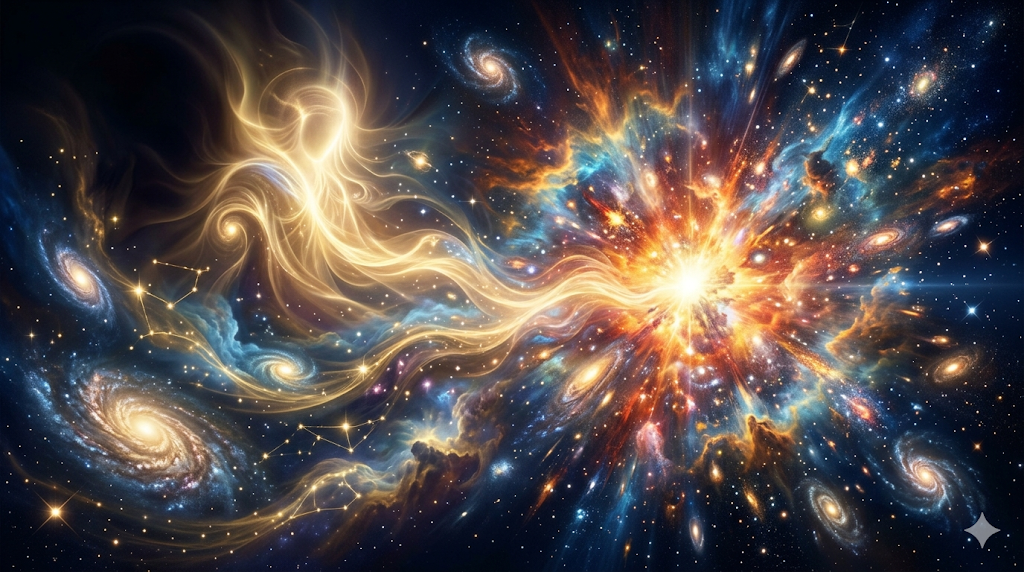
Before time was a measurement, before matter occupied space, and before the first photon pierced the absolute dark — what existed? This question is the ultimate inheritance of the human species, the first curiosity that sparked in the minds of our ancestors as they gazed at the stars from the savannahs of Africa and the deserts of the Levant. We are the only creatures known to look at the horizon and ask not just what is over it, but how the horizon itself came to be. This inquiry marks the true beginning of the story of humanity, a journey that spans the rise of ancient civilizations and the birth of modern physics. The search for the “First Cause” has historically followed two primary paths: the path of Revelation and the path of Observation. For millennia, the Abrahamic faiths — Judaism, Christianity, and Islam — have provided a narrative of intentionality, describing a universe spoken into existence by a Divine Will. In the last century, however, the language of mathematics and the tools of deep-space observation have offered a different script, one written in the language of cosmic inflation and thermodynamic cooling known as the Big Bang. To understand the story of humanity, we must first understand the stage upon which that story is set, placing the ancient scripts of the Bible and the Qur’an alongside the elegant equations of modern cosmology to see where they diverge and where they might unexpectedly meet.
In the Abrahamic tradition, the universe is not seen as an accident of physics but as a deliberate product of purpose. While the three major faiths share a root in the belief of a singular Creator, their specific texts and interpretive traditions offer distinct layers of detail regarding the inception of reality. Within Judaism, the foundation is laid in the Torah, where the account of Genesis describes a transition from Tohu wa-Bohu — a Hebrew phrase often translated as “formless and void” or “utter chaos” — into a state of sublime order. Jewish thought emphasizes that creation was not a one-time event but is an ongoing process; a central tenet of Jewish liturgy is the belief that the Creator “renews each day, continuously, the work of creation.” Furthermore, mystical Jewish traditions, particularly the Kabbalah, introduce the concept of Tzimtzum, or divine contraction. This theory suggests that God had to “withdraw” or contract His infinite light to create a conceptual space where a finite universe could exist. This metaphysical contraction bears a striking, if symbolic, resemblance to the scientific idea of a singularity expanding outward, suggesting a shift from an infinite state to a finite, structured reality.
The Christian perspective builds upon this Judeo-Christian foundation but introduces the profound concept of the Logos, or “The Word,” as the active agent of creation. In the Gospel of John, the narrative begins by stating that “In the beginning was the Word… and through Him all things were made.” This adds a layer of intellectual and rational order to the act of creation, suggesting that the universe is built upon a divine logic or reason. For the Christian tradition, creation is not merely a display of power but an act of communication. The cosmos is viewed as a “First Revelation,” where the laws of nature are seen as a reflection of the Creator’s mind. Throughout Christian history, this has led many scholars to view the study of nature — science itself — as a way of “thinking God’s thoughts after Him.” This theological framework allows for a bridge between the ancient six-day narrative and the modern understanding of a vast, ancient universe, as the focus remains on the intent and the rationality behind the mechanics rather than the literal duration of the creative act.
The Islamic narrative, meanwhile, offers a perspective that emphasizes the absolute sovereignty and unity of Allah through a series of vivid, cosmic descriptions. Like its predecessors, the Qur’an mentions creation occurring in six “Ayyam,” but the Arabic term for day suggests an eon or a significant period of time rather than a twenty-four-hour solar cycle. The Islamic view is uniquely characterized by its descriptions of the heavens and earth being a “joined entity” before being split apart, a concept known as Ratq and Fatq. This mirrors the idea of an initial unity that preceded the diversity of the material world. Additionally, the Qur’an describes the early state of the universe as “smoke” (Dukhan), a term that aligns with the scientific description of a primordial gaseous state. Perhaps most remarkably, the Qur’an speaks of the heavens being built with “strength” and that God is “its expander” (Surah 51:47). In an era where the static universe was the global scientific consensus, this scriptural reference to a dynamic, expanding cosmos provides a fascinating point of intersection with the 20th-century discovery of the expanding universe.
As the path of Revelation describes the “Who” and the “Why,” the path of Observation seeks to uncover the “How” through the lens of science. For most of human history, the scientific consensus favored a static and eternal universe — an infinite steady state. This paradigm shifted dramatically in the 1920s when Edwin Hubble observed that galaxies were receding from us in every direction, implying that if the universe is expanding today, it must have been infinitely smaller and denser in the distant past. Current cosmological models suggest that approximately 13.8 billion years ago, the entire observable universe was compressed into a point of infinite density and heat known as a singularity. The journey from that moment is one of unimaginable extremes, beginning with the Planck Epoch where the known laws of physics did not yet exist. In a fraction of a second, the universe underwent an exponential expansion called inflation, smoothing out energy before cooling enough for the first protons and neutrons to forge the nuclei of hydrogen and helium in a cosmic furnace.
The story of the physical universe continued as it cooled further, eventually reaching a point three hundred and eighty thousand years later where electrons could bind to nuclei. This rendered the universe transparent, allowing the first light to escape and travel across the cosmos — a light we still detect today as the Cosmic Microwave Background Radiation. Following this was a period of darkness that lasted for millions of years until gravity finally pulled vast gas clouds together to ignite the first stars, marking the “Cosmic Dawn.” In this scientific narrative, the Big Bang is not an explosion into an existing room but the very expansion of space-time itself. It describes a universe that is dynamic, cooling, and governed by measurable forces like gravity and electromagnetism.
When comparing these perspectives, the differences in their core attributes become clear. While the religious view posits a beginning Ex Nihilo — out of nothing — triggered by Divine Will, the scientific view identifies a singularity as the sudden expansion of space-time. The measurement of time itself varies from the symbolic or literal “Ayyam” of the Abrahamic faiths to the mathematically derived 13.8 billion years of cosmology. Furthermore, the mechanisms of creation differ fundamentally: religion points to the “Word” or an intentional command, whereas science relies on the immutable laws of physics, such as gravity and thermodynamics. Ultimately, religion seeks to reveal a purpose — the manifestation of glory and a home for humanity — while science focuses on the properties of matter, leaving the question of “Why” outside its empirical scope.
The relationship between these perspectives is often framed as a conflict, yet a deeper analysis suggests they may operate in what the late paleontologist Stephen Jay Gould called “Non-Overlapping Magisteria.” Science documents the factual character of the natural world and develops theories to explain these facts, while religion operates in the realm of human purposes, meanings, and values. In this framework, the Big Bang explains the mechanics of the engine, while religion describes the intent of the driver. One area where these two domains frequently intersect is the “Anthropic Principle,” or the fine-tuning of the universe. Physics has revealed that if the fundamental constants of nature were different by even a fraction of a percentage, stars would not form and life would be impossible. To a scientist, this might be a remarkable coincidence or a sign of a multiverse; to a believer, this is the signature of the Creator, evidence that the universe was designed with the intention of hosting the story of humanity.
This leads to the profound realization that creation may not be a single, finished event buried in the distant past, but rather a continuous and ongoing process. In physics, the universe is still expanding, stars are still being born in nebulae, and heavy elements are still being forged in the hearts of dying suns. Similarly, many theological thinkers describe a “Continuous Creation,” suggesting that the Divine does not simply start the clock and walk away, but actively sustains the existence of every atom at every moment. When we look at the origin of the universe, we are not just looking at a historical curiosity; we are examining the foundation of our own existence. Whether we view the Big Bang as a random fluctuation of a vacuum or as the “Let there be light” of a Creator, the result is the same: a vast, beautiful, and terrifyingly complex stage. The creation of the universe provided the lighting, the backdrop, and the laws of the game, but a stage is empty without actors. The atoms forged in the first three minutes of the Big Bang and the “dust of the earth” mentioned in ancient scripts eventually coalesced into something even more mysterious than a star. If the universe had a beginning, and the stage was set with such precision, what about life itself? How did the breath of life or the primordial soup turn inanimate matter into a creature that could ask these questions, and if the universe has a beginning, what does that say about the arrival of life? In our next chapter, we move from the cosmic scale to the biological, exploring the origins of life and the first appearance of the human soul in the journey of humanity.