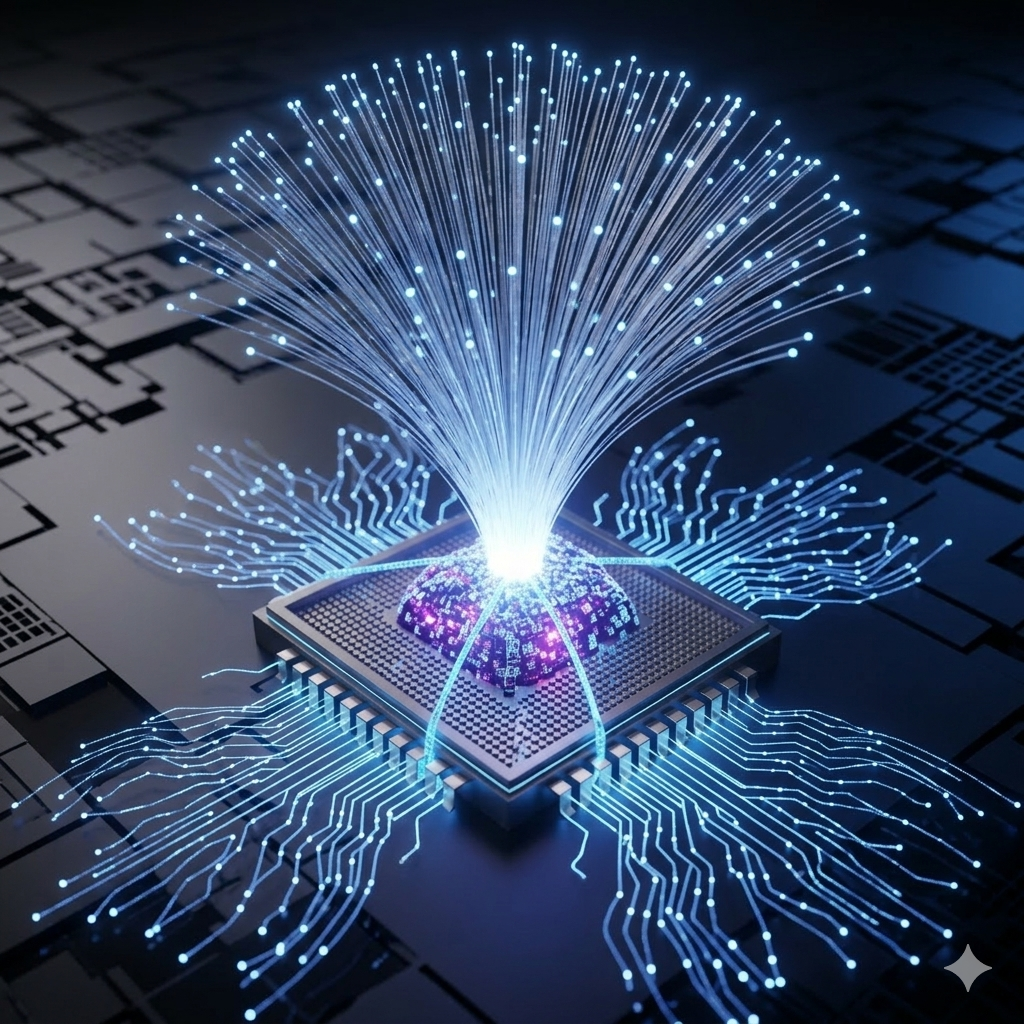
For a long time, the world of technology followed a simple rule: “Faster is better.” We wanted higher speeds and more powerful chips so our apps would open instantly and our games would look better. But recently, a big change happened. Your phone stopped being just a fast calculator and started acting more like a brain. It can recognize your face, translate speech as you hear it, and even have a conversation with you without needing an internet connection.
This change isn’t because of the standard chips we’ve used for years, like the CPU or the GPU. Instead, it is thanks to a new type of processor called the Neural Processing Unit (NPU). This is a massive shift in how computers work. We are moving away from machines that just follow a list of rules and toward machines that can actually recognize patterns.
To understand the NPU, we have to look at why our old chips are struggling with AI. For seventy years, computers have used a design called the von Neumann architecture. Imagine the processor and the memory live in two different houses on opposite sides of a very narrow road. Every time the processor wants to do some work, it has to send a truck down that road to get data from the memory house and bring it back.
AI is incredibly demanding. It requires millions of tiny calculations called “Multiply-Accumulate” ($MAC$) operations every second. On a standard chip, the “road” between memory and the processor becomes a massive traffic jam. The energy cost of moving data is actually much higher than the cost of doing the math. In fact, moving a single piece of data can be 700 times more expensive in terms of battery life than the calculation itself.
This creates a “heat wall.” If we tried to run modern AI on a normal chip, your phone would get too hot to touch in a matter of seconds. The NPU was built specifically to solve this. It is designed to stop moving data back and forth and instead keep the data right where the work is happening.
While a normal CPU handles data like a single person doing one task at a time, the NPU handles it like a giant, perfectly timed assembly line. This is called a Systolic Array.
Think of a systolic array as a grid of tiny workstations. In a traditional chip, the “knowledge” (the AI’s weights) has to be fetched for every single question. In an NPU, we load that knowledge into the grid and keep it there. We call this a Weight-Stationary flow. The “questions” (the data you want to process) then flow through the grid like water through a pipe.
As the data passes through each workstation, the grid does a bit of math and passes the result to the next station immediately. Because the results don’t have to go back to the main memory house until the very end, the NPU saves a massive amount of energy. This allows the chip to perform trillions of operations per second (TOPS) while staying cool and saving your battery.
In traditional math, like at a bank, you need to be 100% accurate. But AI is different; it works more like a human brain. If you see a blurry picture of a cat, you still know it’s a cat. The NPU uses this to its advantage through a trick called Quantization.
Instead of using big, complex numbers, we round them down to much smaller integers (INT8 or INT4). This is like changing a high-definition video into a smaller file size that still looks great on a small screen. By doing this, we make the AI model four to eight times smaller. This allows the entire “brain” of the AI to fit inside the chip’s own fast memory, removing the need to use that slow, narrow road to the main memory house.
There is also a trick called Sparsity. AI models are often full of “zeros,” which are basically empty spaces that don’t do anything. A normal chip wastes energy multiplying by zero anyway. A smart NPU uses “Zero-Value Gating” to see a zero coming and simply skip it. By only doing the math that actually matters, the NPU saves even more power and gets the job done much faster.
One of the smartest things about the NPU is how it manages its “short-term memory.” A normal CPU uses something called a cache, which is basically a hardware system that tries to guess what data you might need next. If it guesses wrong, everything slows down while it goes to find the right data.
The NPU replaces this guessing game with a Software-Managed Scratchpad. Because AI tasks are very predictable, the NPU’s software can act like a grand conductor. It knows exactly what data will be needed and when. It uses a technique called Double-Buffering to bring in the next set of data while the chip is still working on the current set. This ensures the processor is never waiting around for information, making the whole system run with perfect, reliable timing.
In this new era, we don’t care as much about Gigahertz (GHz) anymore. That number doesn’t tell you how smart your phone is. Instead, we look at $TOPS/W$ (Operations Per Watt). This is like the “miles per gallon” for AI. It tells us how much thinking a chip can do for every bit of battery it uses.
For you, this means a better experience in the moment. Cloud-based AI, like the kind that runs in a giant data center, is built to handle thousands of people at once. But your phone needs to respond to you instantly. This is called “Batch Size 1” performance. The NPU is built to give you a sub-millisecond response, so your voice assistant or camera feels instant rather than having a “lag” or delay.
We are currently moving away from “Cloud AI” and toward Edge AI. In the past, your data had to be sent to a giant server far away to be processed. Today, thanks to the NPU, we are running powerful models like Llama-3 directly on our phones.
By keeping the “thinking” on your device, the NPU solves three big problems:
The rise of the NPU marks the end of an era where we just tried to make chips faster. We have hit a “power wall” where we can’t just keep making things run at higher speeds without them overheating. The NPU is the solution: a shift toward “Intelligence per Joule.”
As AI becomes the main way we use our phones, watches, and cars, the NPU has become the most important part of the chip. It is no longer enough for a computer to be fast; it must be designed to understand the world around it. We are no longer just building machines that calculate; we are finally building machines that can perceive and learn.