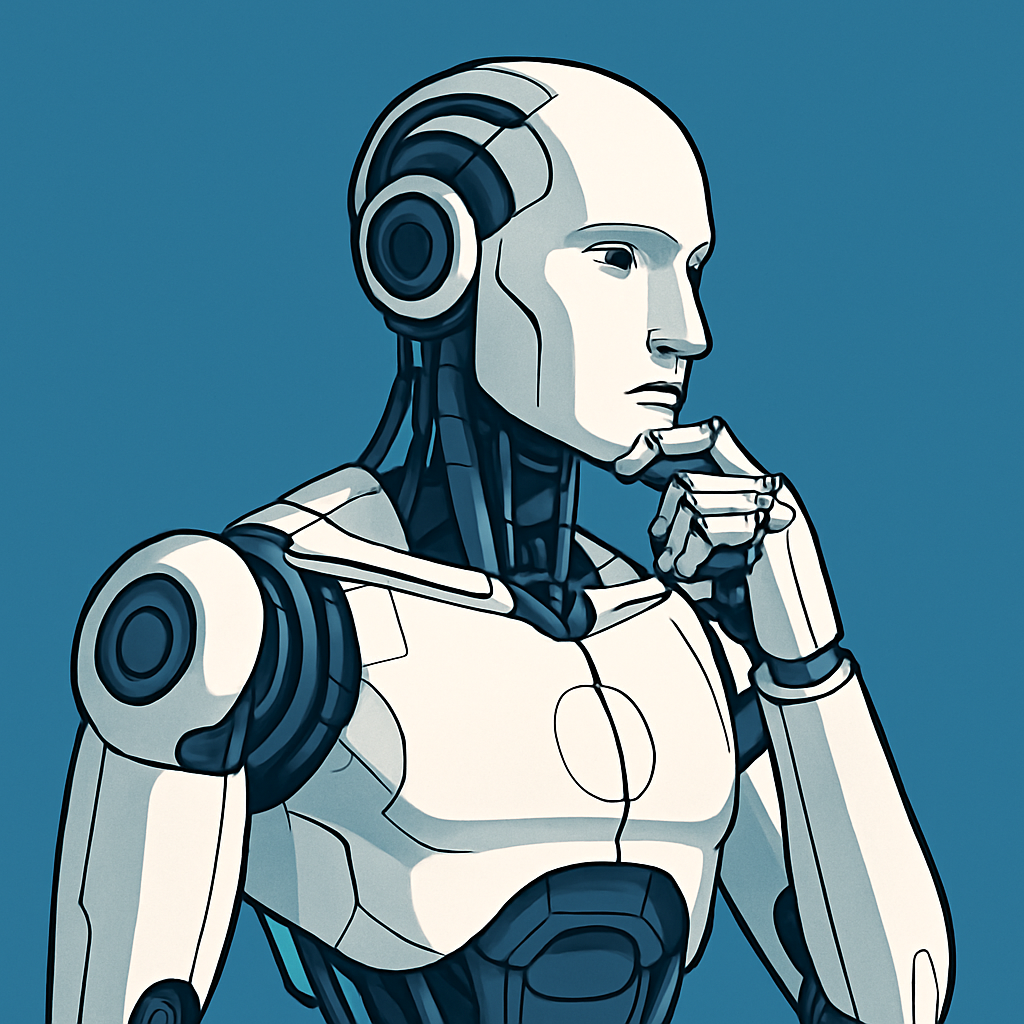
Artificial Intelligence (AI) is revolutionizing industries, reshaping education, and powering our digital interactions. But a question that often emerges, even among professionals, is deceptively simple:
“Is AI truly intelligent?”
Let’s unpack that.
At its core, today’s AI (especially systems like ChatGPT) is a language model trained to predict the next word in a sentence. It doesn’t think, feel, or understand in the way a human does. It has no consciousness or awareness. It doesn’t “know” anything in the human sense of the word. These systems are built on complex neural networks, vast mathematical structures that have been fed a massive corpus of text data from books, articles, and websites.
During this training, the AI learns patterns and statistical correlations between words and concepts. It’s like a highly sophisticated pattern-matching machine. When you ask it a question, it doesn’t access a store of knowledge it “knows.” Instead, it analyzes your prompt, compares it to the patterns it has learned, and generates the most statistically likely response. It effectively completes a complex pattern in a way that appears coherent and logical.
So, is it just a glorified auto-complete? Not quite. Its ability to handle complex and nuanced prompts makes it far more advanced than that, but it is fundamentally a system of pattern recognition, not genuine thought.
While we’ve established that AI operates on pattern recognition, it’s the underlying architecture that makes this so powerful. The neural network that powers modern large language models like ChatGPT is called a Transformer. First introduced in a 2017 paper by Google titled “Attention Is All You Need,” the transformer architecture fundamentally changed how AI processes language.
Before transformers, most language models processed text sequentially, one word at a time. This made it difficult for them to understand the relationship between words that were far apart in a sentence. The transformer architecture solved this problem with a key innovation: the self-attention mechanism.
This mechanism allows the model to process all the words in a sentence at the same time and weigh the importance of each word relative to every other word. For example, in a long, complex sentence, the model can instantly recognize that a pronoun near the end refers to a noun at the beginning, understanding the full context without having to read through the sentence word-by-word. This ability to capture these “long-range dependencies” is what enables AI to generate text that is so coherent and contextually relevant.
Despite its limitations, AI feels intelligent because of its remarkable ability to mimic human-like outputs.
But all of this is based on pattern recognition, not genuine thought. It doesn’t truly understand what it’s saying, and it doesn’t verify facts unless explicitly trained to do so.
When we compare AI and human intelligence, the differences become clear. Human intelligence is characterized by consciousness and self-awareness — the ability to be aware of oneself and one’s surroundings, and to think about one’s own thoughts. Current AI lacks both of these qualities entirely.
Furthermore, human intelligence is built on real-world experience. We learn from interacting with our physical and social environments. A child learns to fear a hot stove because of a painful sensory experience, not because they read about heat. AI, on the other hand, is confined to the data it was trained on and has no direct sensory experience of the world. This is a core concept known as embodied cognition, which argues that intelligence is deeply connected to our physical interactions with the world.
This also means that human understanding is conceptual and contextual, allowing us to grasp the meaning behind a concept, while AI’s “understanding” is merely a statistical correlation between words. It doesn’t comprehend the underlying meaning. For example, an AI could write a joke, but it doesn’t “get” the humor in the same way a human does.
Finally, human intelligence allows for learning after deployment. We continuously learn and adapt from new experiences. While AI models can be “fine-tuned” with new data, they do not possess the same continuous, autonomous learning capability as humans. Human intelligence is also deeply intertwined with emotion and empathy, which are crucial for social interaction and ethical decision-making. AI can only simulate these qualities based on patterns it has observed.
The Two Definitions of Intelligence
To answer this question, we must first agree on what “intelligence” means. There are two primary ways to define it, and AI fits into only one of them:
Therefore, the most accurate way to describe AI’s current state is that it is a powerful simulation of intelligence, not intelligence itself. It’s like a brilliant actor who can perfectly portray a character’s emotions and thought processes without actually feeling them. The performance is convincing, but the underlying reality is different.
As AI becomes increasingly integrated into our lives, understanding its fundamental nature is more important than ever.
True intelligence remains a human trait. AI is just helping us scale it, faster, broader, and more efficiently.
What do you think? Is AI intelligent or just good at faking it?
Let’s start the conversation.
#ArtificialIntelligence #MachineLearning #AIethics #ChatGPT #LLM #TechTrends